
September 24, 2026 — Editorial Team
7 Best Functional Fitness Workouts for Firefighters

Table of Contents
- Why Functional Fitness Beats Standard Gym Training for Firefighters
- 1. Weighted Vest and Gear-Specific Training
- 2. Sled Pushes and Sled Drags
- 3. Farmers Carries and Grip Strength Work
- 4. Stair Climbing and Stepmill Intervals
- 5. High-Intensity Interval Training (HIIT) Protocols
- 6. Core Stability and Injury Prevention Exercises
- 7. Circuit Training: Tactical Strength and Conditioning for First Responders
- How to Build a Weekly Plan Around Shift Work
- Frequently Asked Questions
Last Updated: September 24, 2026
Why Functional Fitness Beats Standard Gym Training for Firefighters
Functional fitness is the practice of training movements that mirror the real demands of the job: dragging a charged hose, forcing a door, carrying a downed victim, and climbing stairs under load. According to the National Institute for Occupational Safety and Health (NIOSH) firefighter fatality research, sudden cardiac events remain the leading cause of on-duty firefighter deaths, which is exactly why training that builds work capacity matters more than training that builds mirror muscles. This guide from Thor's Power breaks down the seven best functional fitness workouts for firefighters, with practical programming you can run at a station gym or a bare-bones garage setup. Every session below targets the movements, energy systems, and durability that fireground performance actually requires.
1. Weighted Vest and Gear-Specific Training
Weighted vest training is the closest you can get to fireground conditions without turnout gear, and it should anchor one session per week. Start at roughly 10% of body weight and progress slowly, teaching your trunk, hips, and ankles to handle an external load while you move.
A simple vest circuit:
- 5-minute brisk walk or incline treadmill at a fast pace
- 10 walking lunges per leg
- 20 step-ups onto a 45-50 cm box
- 30-second plank hold
- Repeat 3-4 rounds
Wear the vest for the whole circuit, then remove it for the last round. This trains the deceleration and stability your knees need on a ladder or stairwell.
2. Sled Pushes and Sled Drags
Sled work builds explosive power and anaerobic capacity without running's joint pounding, making it ideal for older firefighters or anyone returning from a knee issue. A sled push mimics moving a victim or advancing a line; a sled drag mimics pulling hose or hauling equipment.
Alternate heavy short pushes with lighter long drags:
- 6 x 20-meter heavy sled push, rest 60 seconds
- 4 x 20-meter backward sled drag, rest 60 seconds
Keep your chest up and drive through the whole foot. If you don't have a sled, a heavy tire flip or a resisted band sprint gets you similar adaptations.
3. Farmers Carries and Grip Strength Work
Grip is the first thing to fail on a real call, if you can't hold a tool, ladder, or victim, nothing else matters. Farmers carries train grip, core stability, and posture at once.
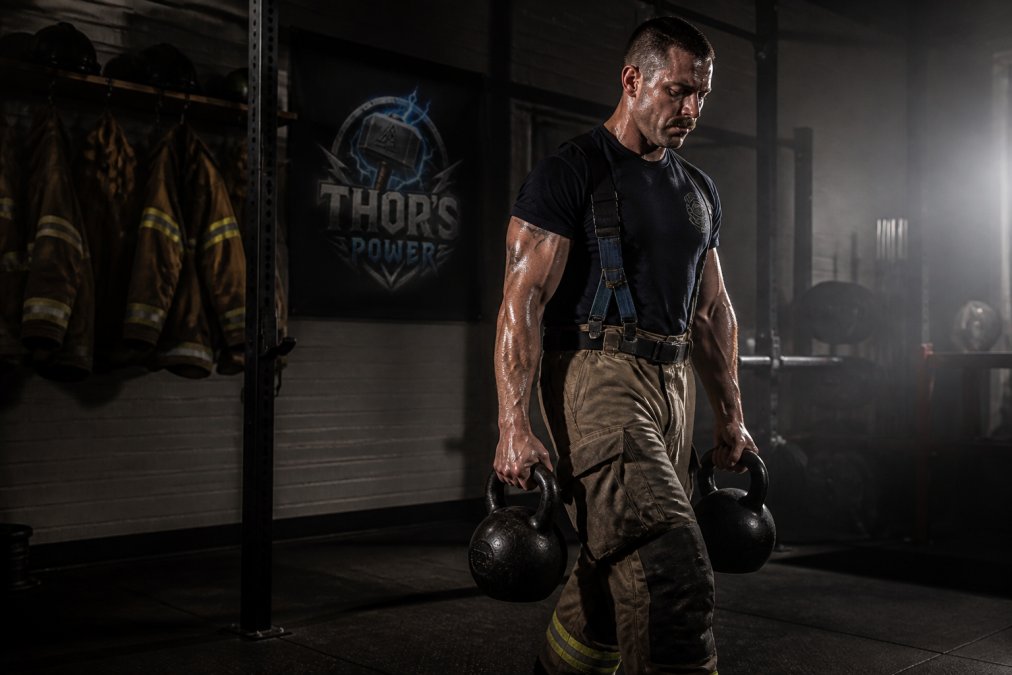
Run carries as a finisher two or three times a week:
- 4 x 30-meter heavy farmers carry, rest 45 seconds
- 3 x 20-second dead hang from a pull-up bar
- 2 x 30-meter suitcase carry, one side at a time
The suitcase carry exposes and fixes side-to-side weaknesses, which matters when you're dragging an uneven load through a doorway.
4. Stair Climbing and Stepmill Intervals
Stair climbing is the most job-specific cardio you can do. High-rise response means climbing with gear, then working while your heart rate stays elevated, stepmill intervals build that exact capacity.
A 20-minute session:
- 5 minutes easy pace to warm up
- 10 rounds of 30 seconds hard, 60 seconds easy
- 3 minutes cool down at a walk
No stepmill? Stadium stairs or a stairwell in full gear (supervised, with a partner) works. Track recovery heart rate over weeks, a dropping rate is one of the clearest signs your cardiovascular endurance is improving.
5. High-Intensity Interval Training (HIIT) Protocols
HIIT trains the anaerobic threshold you cross the moment you go on air. Keep work intervals short and honest, then let recovery do its job.
A station-friendly HIIT circuit:
- 30 seconds battle ropes, 30 seconds rest
- 30 seconds kettlebell swings, 30 seconds rest
- 30 seconds burpees, 30 seconds rest
- 30 seconds box jumps, 30 seconds rest
- Repeat 4-6 rounds
6. Core Stability and Injury Prevention Exercises
Core stability transfers force from your legs to your upper body and is the foundation of firefighter injury prevention exercises. A stable trunk protects your lower back during lifts, drags, and awkward carries, but the training that protects a 24-year-old recruit isn't the same as what protects a 47-year-old battalion chief with 22 years of nozzle time. Build your core block around your career stage, not a generic template.
Bifröst Energy Patrol Premium No Crash →
The mechanism that matters: anti-rotation and anti-extension. When you drag a charged hose or pull a victim through a doorway, your trunk's job is to resist twisting and resist arching under load. Crunches train neither. Train the brace instead.
Base block (all career stages, 2-3x per week):
- Dead bug, 3 x 10 per side, teaches rib-to-pelvis control without spinal load
- Side plank with reach, 3 x 30 seconds per side, anti-lateral-flexion for suitcase-style loads
- Pallof press, 3 x 12 per side, anti-rotation, the single most job-relevant core pattern
- Bird dog, 2 x 8 per side, spinal stability under limb movement
Recruit and early-career (under 30, first 5 years): You can absorb more volume and loaded carries. Add heavy suitcase carries and offset-loaded step-ups. Build a base that survives a 25-year career, not one that peaks at the academy.
Mid-career (30s to mid-40s): This is where most back injuries accumulate. Shift toward anti-extension work, planks, kneeling ab wheel rollouts, dead-bug variations, and cut loaded spinal flexion. Nagging low-back tightness in veterans often traces to years of heavy carries without enough bracing work.
Late career (mid-40s and beyond): Prioritize durability over load.
7. Circuit Training: Tactical Strength and Conditioning for First Responders
Tactical strength and conditioning for first responders is circuit training organized around job tasks: squat, hinge, push, pull, carry, climb, back to back with minimal rest. It builds work capacity, the ability to keep producing force while tired.
A full-body station circuit:
- Goblet squat, 12 reps
- Dumbbell deadlift, 10 reps
- Push-ups, 15 reps
- Kettlebell swing, 15 reps
- Farmers carry, 30 meters
- Step-ups, 10 per leg
- Repeat 3 rounds, rest 90 seconds between rounds
How to Build a Weekly Plan Around Shift Work
A firefighter workout routine for shift work has to bend around 24-hour shifts, not fight them:
Day Type |
Session Focus |
Duration |
Intensity |
|---|---|---|---|
On shift, quiet |
Circuit training or mobility |
30 min |
Low to moderate |
On shift, busy |
Stair climbs during downtime |
10-15 min |
Moderate |
Post-shift |
Recovery walk, mobility |
20 min |
Low |
Off day 1 |
Sled work plus weighted vest |
40 min |
High |
Off day 2 |
HIIT plus core block |
30 min |
High |
Off day 3 |
Steady-state cardio plus carries |
45 min |
Moderate |
Post-Incident Recovery: The Piece Most Programs Skip
Almost every functional fitness plan for firefighters tells you how to train hard. Few tell you what to do after a working fire, a multi-hour extrication, or four calls back to back, and that gap is where overtraining and burnout start.
A practical post-incident protocol:
- First 24 hours after a high-exertion call or shift: No hard training. Walk, do 10-15 minutes of easy mobility, hydrate aggressively, and eat a real meal with protein and carbs. Sleep is the priority.
- 24-48 hours out: Reintroduce movement, not intensity. A 20-minute easy bike or walk, plus your core stability block at low effort. If your resting heart rate is still elevated above your normal baseline, you're not recovered, wait another day.
- 48-72 hours out: Return to moderate work. Carries, stairs at conversational pace, mobility. Save the sled pushes and HIIT for when your sleep and resting heart rate are back to baseline.
The best program is the one you'll actually run on a bad sleep week, and the one that knows when to stand down. Build three versions of each session: full, short, and minimal. Ten minutes of carries and stairs beats a skipped workout every time, and a deliberate recovery day beats a forced hard session every time.
Frequently Asked Questions
What are the best functional fitness workouts for firefighters?
The seven most effective are weighted vest training, sled pushes and drags, farmers carries, stair climbing and stepmill intervals, HIIT circuits, core stability work, and full-body circuit training. Each one mimics a real fireground demand: carrying gear, advancing hose lines, forcing doors, climbing stairs under load, and dragging a downed victim. Train two to four of these per week, rotating emphasis so you build work capacity without overloading the same joints.
How can firefighters prevent injuries through functional training?
Focus on firefighter injury prevention exercises that strengthen the core, hips, and shoulders while reinforcing safe movement patterns. Deadlifts and squats build the posterior chain used for lifting; single-leg work improves balance on uneven ground; carries and sled drags teach bracing under load. Add deceleration drills and mobility work to protect knees and lower backs. Progress load gradually, warm up thoroughly, and never train heavy lifts to failure while fatigued.
How do I build a firefighter workout routine for shift work?
A firefighter workout routine for shift work should be short, flexible, and equipment-agnostic. Use 20-40 minute sessions built around circuits you can do at the station with kettlebells, sandbags, or bodyweight. Train on duty when calls allow, and keep one longer strength session on an off day. Rotate intensity so a 24-hour shift is not followed by a max-effort day. Prioritize sleep, hydration, and protein to recover between shifts.
What role does recovery play in a firefighter's fitness routine?
Recovery is where adaptation happens. After a structure fire or a heavy training block, your nervous system needs time to reset. Schedule at least one full rest day per week, use light mobility work on active recovery days, and get 7-9 hours of sleep when possible. Hydration and consistent protein intake support muscle repair. Post-incident recovery protocols, including stress management and decompression, matter as much as the workouts themselves.
How does tactical strength and conditioning for first responders differ from general fitness?
Tactical strength and conditioning for first responders prioritizes work capacity under load, grip endurance, and the ability to recover quickly between bursts of effort. General fitness may focus on aesthetics or single-muscle isolation; tactical training uses compound movements like deadlifts, carries, sled work, and stair climbs that mirror fireground tasks. The goal is not to look strong but to stay effective from the first alarm to the last overhaul.