
September 20, 2026 — Editorial Team
Clean Energy Supplements for Police Officers: 2026 Guide

Table of Contents
- Why Clean Energy Supplements Matter for Police Officers
- What to Look for in Clean Energy Supplements for Police Officers
- Nutrition Tips for Police Officers Working Long Shifts
- Supplements for Night Shift Workers: Circadian Rhythm Support
- The Best Pre Workout for First Responders: What to Evaluate
- Hydration, Electrolyte Balance, and Duty Gear Load
- Conclusion: Building a Clean Energy Routine for the Job
- Frequently Asked Questions
Last Updated: September 20, 2026
Why Clean Energy Supplements Matter for Police Officers
Ask any officer what ends a shift early, and fatigue tops the list. Clean energy supplements for police officers are formulated to support alertness and focus without the hard spike-and-crash cycle that comes from pounding canned energy drinks. At Thor's Power, we built our entire line around that problem because our founder wore the badge.
A 12-hour shift rarely means 12 hours of steady activity. It means long stretches of sitting, sudden bursts of physical demand, and report writing at 3 a.m. Your energy needs follow that pattern, not a gym workout's.
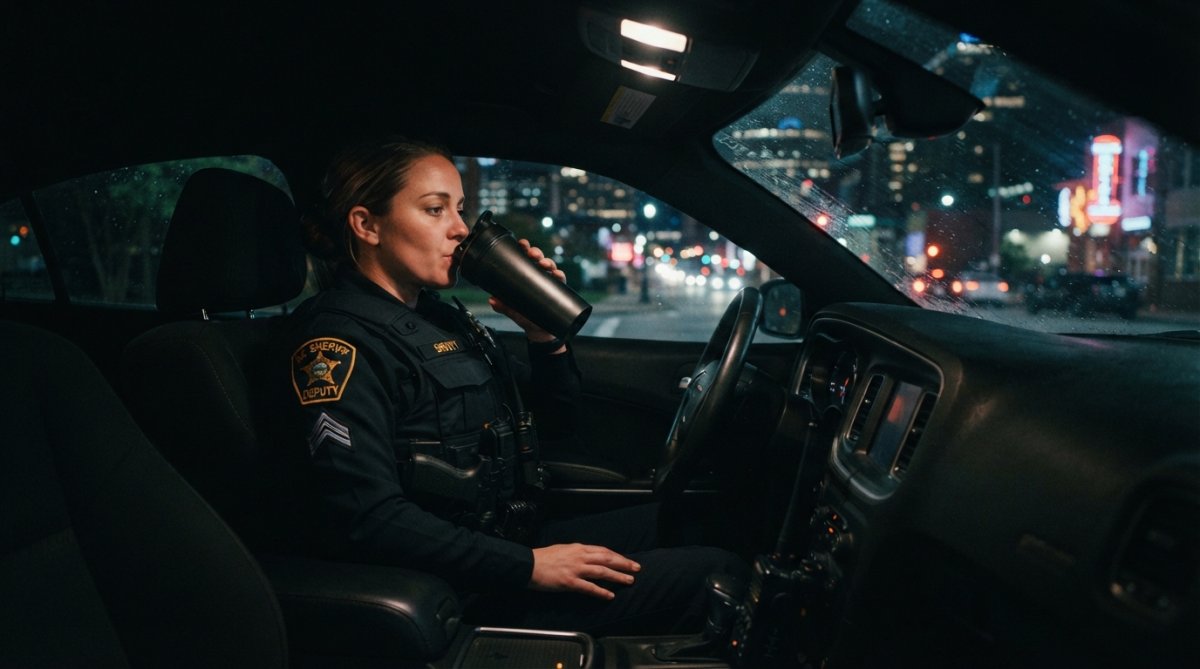
How Shift Work Disrupts Energy and Circadian Rhythm
Circadian rhythm is the body's internal 24-hour clock that regulates sleep, hormone release, and alertness. Rotating shifts scramble that clock, so your body never fully adapts to any schedule.
Many officers on rotating shifts report that the first two days after a schedule flip feel the worst. A common approach is to keep sleep and meal timing as consistent as possible, even on days off.
Caffeine Tolerance and the Crash Cycle
Caffeine tolerance builds fast. What once took one cup starts taking three, and the crash gets steeper each time.
The problem isn't caffeine itself. It's caffeine as the only active ingredient. Formulas that pair caffeine with focus-supporting compounds tend to feel steadier than straight stimulant loads.
What to Look for in Clean Energy Supplements for Police Officers
Start with the label, not the marketing. A clean energy supplement should list every ingredient with its exact amount, carry third-party testing, and avoid proprietary blends that hide dosages.
Three things separate a serious formula from gas-station noise:
- Full transparency, every ingredient and dose printed on the label
- Third-party testing for purity and label accuracy
- Ingredients chosen for focus and endurance, not just stimulation
Third-Party Testing and Dietary Integrity
Third-party testing means an independent lab verifies what's actually in the tub. Without it, you're trusting a label that no outside party has checked.
Look for a certificate of analysis you can request. Reputable brands publish these or provide them on request. If a company won't show you testing documentation, that tells you something.
Drug Testing and Banned Substance Safety
This is the angle most supplement guides skip entirely, and it matters more for officers than anyone. A failed drug test can end a career, and some stimulants and "proprietary" blends have landed users in exactly that position.
Before you take anything, check the ingredient list against your department's policy and any banned substance lists that apply to your role. When in doubt, ask your agency's medical or HR contact before you buy, not after.
Nutrition Tips for Police Officers Working Long Shifts
Food timing does more for sustained energy than most supplements can. Nutrition tips for police officers usually come down to eating on a schedule instead of eating when the radio goes quiet.
Pack food you can eat cold and one-handed. Shift work doesn't offer sit-down meals.
Bifröst Energy Patrol Premium No Crash →
- Protein at every break to blunt energy dips
- Complex carbs before a long stretch, not sugar
- A small snack around the 8-hour mark to bridge the back half
- Water within arm's reach the entire shift
What most guides miss is the meal-prep angle.
Supplements for Night Shift Workers: Circadian Rhythm Support
Supplements for night shift workers should support alertness during dark hours and wind-down afterward, not just blast stimulants. The goal is to work with your shifted clock, not against it, and that requires understanding what your body is actually doing at 3 a.m.
What Happens to Your Body on a Night Rotation
Your circadian rhythm is driven largely by light exposure. When you work through the night, you're asking your body to be alert during its biological low point and to sleep during its biological high point. Two hormones do most of the work here:
- Cortisol normally peaks in the early morning to promote wakefulness. On a night shift, that peak arrives while you're trying to sleep.
- Melatonin normally rises in the evening to promote sleep. On a night shift, it rises while you're on duty, contributing to the mid-shift fog that hits hardest between roughly 2 a.m. and 5 a.m.
Supporting Alertness During the Shift
A few ingredients show up repeatedly in formulas built for this purpose, and each works through a different mechanism:
- L-theanine pairs with caffeine to smooth the stimulant edge without killing alertness. A common ratio is roughly 1:1 or 2:1 theanine to caffeine.
- Rhodiola rosea is an adaptogen often used for fatigue resistance during prolonged mental work. It's not a stimulant, so it won't stack into a crash.
- B-vitamins, particularly B12 and B6, support energy metabolism and are commonly included in shift-work formulas.
- L-tyrosine is an amino acid precursor to dopamine and norepinephrine, both involved in focus under stress.
Supporting Sleep After the Shift
Getting to sleep after a night shift is the harder half of the problem. A few evidence-informed approaches:
- Blackout curtains or a sleep mask. Light is the strongest signal to your circadian system. Blocking it is the single highest-leverage change.
- A consistent wind-down routine. The same sequence every morning, shower, light meal, dark room, trains your body to expect sleep.
- Magnesium glycinate is commonly used in the evening for relaxation support. It's not a sedative, but many practitioners find it helps with wind-down.
- Melatonin, used carefully. It's a timing signal, not a sleeping pill. Small doses taken at the same time each morning are the common approach. Check with your agency's medical contact before adding it, since policies vary.
Rotating Schedules Make This Harder
If you're on a rotating schedule rather than a fixed night shift, your body never fully adapts to any pattern. The first two days after a schedule flip tend to feel the worst, and there's no supplement that eliminates that transition.
What to Look For in a Night-Shift Formula
A formula built for night rotations should pair a moderate caffeine dose with focus-supporting compounds like L-theanine and L-tyrosine, include adaptogens like rhodiola for fatigue resistance, and avoid the high-stimulant, no-theanine profile of conventional pre-workouts. It should also be transparent about dosing, so you can time your intake around your sleep window rather than guessing.
The Best Pre Workout for First Responders: What to Evaluate
The best pre workout for first responders is one you can take before a shift or a training session without a hard crash three hours later. That rules out most conventional pre-workouts built for a 60-minute gym window.
Evaluate on four criteria:
Criteria |
What to Look For |
Why It Matters |
|---|---|---|
Caffeine dose |
Moderate, around 150 mg |
Enough to sharpen, not enough to spike |
Focus ingredients |
L-theanine, L-tyrosine, Alpha GPC |
Support attention without jitters |
Transparency |
Full label, no proprietary blend |
You know exactly what you're taking |
Testing |
Third-party verified |
Protects against banned substances |
Hydration, Electrolyte Balance, and Duty Gear Load
Add 20 pounds of duty gear in summer heat and hydration stops being optional. Electrolyte balance affects cognitive focus as much as physical performance, and dehydration mimics fatigue in ways caffeine can't fix.
Conclusion: Building a Clean Energy Routine for the Job
The hardest part isn't finding a supplement. It's building a routine that holds up on a rotating schedule, when your body never quite knows what time it is.
Frequently Asked Questions
What is the best clean energy supplement for shift work?
The best clean energy supplements for shift work pair moderate caffeine with ingredients that support focus and stress response, rather than relying on stimulants alone. Look for transparent labels, third-party testing, and no proprietary blends. A formula with 150 mg caffeine plus L-theanine, L-tyrosine, and rhodiola rosea can support sustained energy without the hard crash that comes from high-sugar energy drinks.
How do clean energy supplements differ from traditional energy drinks?
Traditional energy drinks often load 200 mg or more of caffeine with sugar, taurine, and artificial colors. Clean energy supplements for police officers typically use moderate caffeine, no sugar, and ingredients like L-theanine and B-vitamins to support cognitive focus and sustained energy. The goal is a smoother curve, not a spike-and-crash. Powdered formats also let you control serving size and avoid the canned-drink cost per serving.
Are there ingredients first responders should avoid in supplements?
Yes. Avoid proprietary blends that hide doses, excessive caffeine above 300 mg per serving, and ingredients banned by drug-testing programs. Some pre-workouts contain stimulants or compounds that can trigger a positive test. Look for third-party tested products with fully disclosed labels. If you are subject to random drug testing, check every ingredient against your department policy and the WADA prohibited list before using any supplement.
How can police officers maintain steady energy levels throughout a 12-hour shift?
Eat small protein-and-fiber meals every three to four hours, drink water consistently, and use a moderate-caffeine supplement early in the shift rather than late. Pair caffeine with L-theanine to smooth the effect. Avoid heavy processed foods that cause energy dips. A 150 mg caffeine serving at the start of shift, plus hydration and a light snack mid-shift, supports steadier energy than repeated energy drinks.