
October 24, 2026 — Editorial Team
How to Improve Sleep Quality for Police Officers

Table of Contents
- Why Sleep Quality Matters for Police Officers
- Build a Police Officer Night Shift Sleep Schedule That Works
- How to Sleep After a Night Shift
- Napping Strategies for Night Shift Workers
- Shift Work Sleep Disorder in Police Officers
- Wind-Down Routine, Caffeine, and Sleep Hygiene on the Job
- Frequently Asked Questions
Last Updated: October 18, 2026
Why Sleep Quality Matters for Police Officers
Sleep is the foundation of every decision an officer makes on shift. Learning how to improve sleep quality for police officers starts with understanding what poor sleep actually costs.
The CDC's guidance on shift work and long hours is blunt about it: shift workers face higher risks of chronic fatigue, injury, and long-term health problems. For police, that risk shows up in split-second moments.
The Cost of Sleep Deprivation on the Job
Fatigue slows reaction time, dulls attention, and clouds judgment. Those are the exact skills an officer needs most.
A common mistake is treating tiredness as a badge of honor. In practice, a sleep-deprived officer is a safety risk to themselves, their partners, and the public. Decision-making suffers first, and you may not notice it until after the fact.
How Poor Sleep Affects Physical and Mental Health
Poor sleep hits the body and the mind at the same time. Physical health suffers through weakened immunity and slower recovery. Mental health takes a hit too, with higher stress and lower mood.
Many officers find that sleep deprivation builds over weeks. It shows up as irritability, low energy, and trouble staying sharp during routine tasks.
Build a Police Officer Night Shift Sleep Schedule That Works
A police officer night shift sleep schedule is a planned block of sleep you protect like a shift assignment. The goal is consistency, not perfection. Your internal body clock adjusts to whatever pattern you repeat, so the plan matters more than any single night.
Most officers juggle three patterns: straight days, straight nights, and rotating. Each one needs a different plan. The schedule below is a starting point you can adjust to your department's shift times.
Straight Nights: A Workable Template
If you work a steady night shift, build your day around one protected sleep block and one short pre-shift nap.
- Main sleep: 8:00 a.m. to 2:00 p.m. (a 6-hour block you hold most days)
- Pre-shift nap: 8:00 p.m. to 8:20 p.m. (20 minutes, alarm set)
- Caffeine cutoff: no later than 1:00 a.m., roughly 6 hours before your main sleep block
- Meal timing: a solid meal before shift, a lighter meal around 2:00 a.m., nothing heavy in the last 3 hours before sleep
This template keeps your main sleep anchored in the morning, uses a short nap to cover the pre-shift dip, and keeps caffeine from bleeding into your sleep window.
Anchor Sleep: The Core Block You Protect
Anchor sleep is the one block you never skip. Pick a 4-hour window you can hold most days, even on days off.
Protect that block above everything else:
- Same time, same place, every day
- Phone on do not disturb
- Family and friends know the window
On days off, you can add a second sleep period, but keep the anchor block in place. That single habit is what keeps your body clock from drifting.
Rotating Shifts: How to Adjust Without Wrecking Your Week
Rotating shifts are the hardest pattern to manage. The key is to move your sleep in small steps, not big jumps, and to use light and naps to pull your clock in the right direction.
A common transition plan for moving from days to nights:
- Two days out: stay up 1-2 hours later than usual, and sleep in 1-2 hours
- Day before the switch: shift your bedtime 2-3 hours later, and take a 20-minute nap in the early evening
- First night shift: use bright light early in the shift, eat a light meal around midnight, and avoid caffeine after 2:00 a.m.
- After the first night: go home, dim the lights, and get into your sleep block within 30-60 minutes
For the reverse move (nights back to days), flip the plan: go to bed earlier in 1-2 hour steps, get bright morning light as soon as you wake, and keep naps short so they don't push your bedtime later.
Keep the Plan Realistic
A few rules keep any schedule from falling apart:
- Move your sleep in steps of 1-2 hours per day, never a full flip in one night
- Keep your anchor sleep block intact through every rotation
- Use bright light early in your new awake period and dim light in the hours before sleep
- Avoid long naps that push your schedule later
How to Sleep After a Night Shift
Knowing how to sleep after a night shift comes down to two things: what you do in the first 30 minutes home and how well you control light. Get both right and daytime sleep gets easier.
The Commute Home and the First 30 Minutes
Treat the drive home as part of your wind-down. Skip the bright gas station stop and the heavy meal.
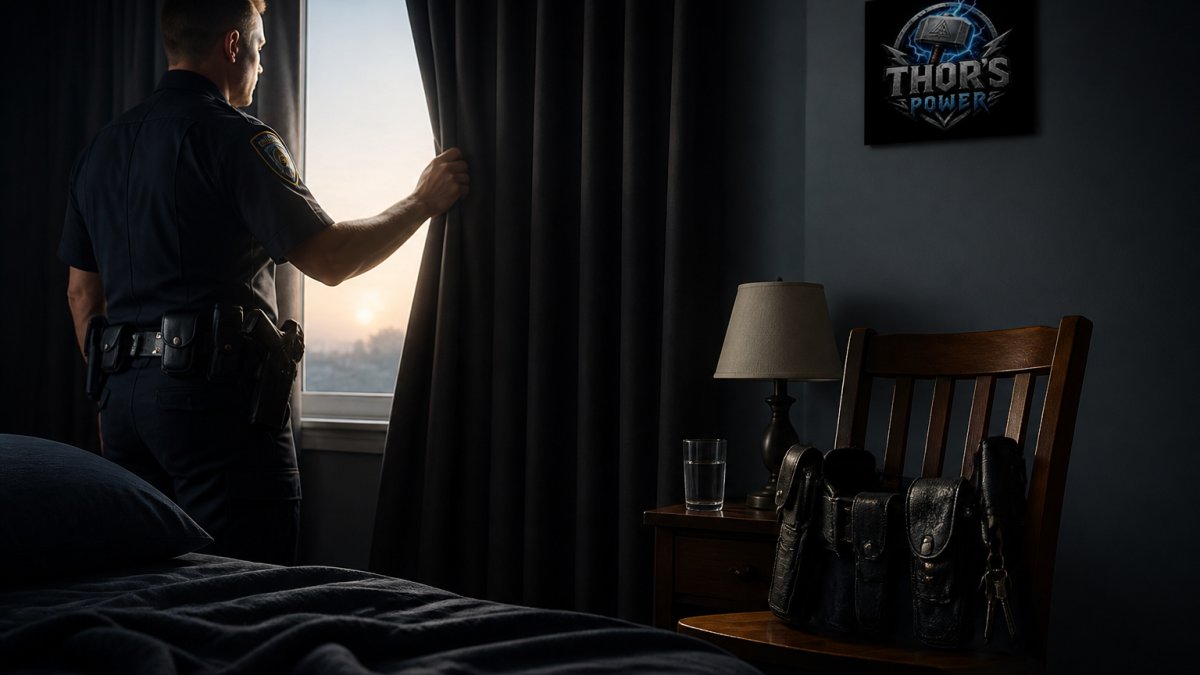
Once home, keep it boring:
- Dim the lights immediately
- Take a quick shower to cool down
- Skip the phone scroll
- Go straight to bed
Light Exposure: Dark Room, Bright Wake-Up
Light is the strongest signal to your internal body clock. Keep your sleep space as dark as you can and your wake-up as bright as you can.
Use blackout curtains and an eye mask. When you wake, get bright light right away to reset your rhythm.
Mimir's Calm - Reishi Calm Drops X2 →
Napping Strategies for Night Shift Workers
Napping is a tool, not a crutch. Napping strategies for night shift workers work best when the nap is short and timed before the shift, not after.
Short naps of 20-30 minutes boost alertness without grogginess. Longer naps can leave you foggy and make it harder to sleep later.
- Nap before your shift, not after
- Keep it under 30 minutes
- Set an alarm so you don't oversleep
- Use a dark, quiet spot
Shift Work Sleep Disorder in Police Officers
Shift work sleep disorder in police officers is a real condition marked by ongoing insomnia and excessive sleepiness tied to shift work. It's more than feeling tired.
Most practitioners look for three things before considering the diagnosis: a work schedule that overlaps your sleep window, insomnia or excessive sleepiness that persists for at least three months, and symptoms that cause problems on the job or in daily life.
Track It Before You Report It
A two-week sleep diary gives a clinician something concrete to work with. Log these each day:
- Bedtime and wake time for your main sleep block
- Total sleep time and how many times you woke up
- Nap times and lengths
- Caffeine, nicotine, and alcohol with times
- Shift start and end times
Bring the diary to your appointment. It turns a vague complaint into a pattern a doctor can act on.
Symptom Checklist: When to Escalate
See a doctor if you notice any of these:
- Persistent daytime sleepiness that doesn't improve with better habits
- Snoring with pauses in breathing, or gasping during sleep
- Headaches on waking
- Trouble focusing on shift, or near-miss driving events on the commute home
- Mood changes, irritability, or low energy that last for weeks
A screening is quick, and treatment can change how you feel on the job. The National Heart, Lung, and Blood Institute on sleep apnea explains the warning signs and pathways.
Sleep Apnea Screening and Treatment Pathways
Sleep apnea is common in shift workers and often missed. Watch for loud snoring, gasping during sleep, or waking up unrefreshed.
A typical pathway looks like this:
- Talk to your primary care provider and bring your sleep diary
- Ask for a sleep evaluation, many providers refer to a sleep specialist or order a home sleep apnea test
- Complete the test as directed, usually overnight
- Review results with your provider and discuss treatment options
- Follow up on treatment and re-check your sleepiness ratings
The FDA's overview of sleep disorder treatment covers the kinds of options doctors use, from behavioral therapy to medication.
Measure Your Progress
Re-score your sleepiness ratings every two weeks. If they aren't improving after a month of consistent habits and any recommended treatment, go back to your provider. Progress you can see is progress you can defend to yourself, your family, and your department.
Wind-Down Routine, Caffeine, and Sleep Hygiene on the Job
A wind-down routine tells your body the day is over. Sleep hygiene for officers means managing caffeine, nicotine, and alcohol with your shift in mind.
Caffeine is useful early in a shift but works against you later. Cut it off several hours before your sleep block. Nicotine is a stimulant too, and alcohol may help you fall asleep but fragments it later.
Build a simple routine:
- Dim lights before bed
- Try deep breathing or relaxation techniques
- Keep a cool, dark, quiet room
- Stay consistent with your sleep schedule
Many officers find that a calming routine makes the biggest difference. Our Mimir's Calm Reishi Calm Drops are a simple addition to an evening wind-down, with a functional mushroom blend to support relaxation, everyday resilience, immune wellness, and overall balance.*

For departments, a fatigue-management checklist helps supervisors spot risk. Track hours, watch for excessive sleepiness, and build rest breaks into schedules. Workplace wellness starts with leadership taking sleep seriously.
Sleep problems don't fix themselves, and a tired officer is a risk to everyone on the street. At Thor's Power, we make performance products for people who work the toughest hours, including our Mimir's Calm Reishi Calm Drops to support relaxation, everyday resilience, immune wellness, and overall balance,* and EIR Ashwagandha to support the body's natural response to everyday stress and promote a sense of calm and balance.* Get started with Thor's Power and build a routine that keeps you sharp, focused, and ready for the next call.


Frequently Asked Questions
How many hours of sleep do police officers get?
Most officers working night or rotating shifts average fewer than the recommended 7 to 9 hours, and the sleep they do get is often fragmented by daytime noise, family obligations, and court appearances. The result is a chronic sleep debt that builds across a work week. Tracking your actual sleep duration for two weeks gives you a realistic baseline. From there, protect a consistent anchor sleep block and use naps to close the gap rather than trying to catch up all at once on days off.
How can officers adjust their sleep schedule when shifts rotate?
Rotate forward, not backward. When schedules change, move your bedtime later rather than earlier, since the body's internal clock adjusts more easily in that direction. Give yourself two to three days per shift change and use bright light in the morning plus a dark, quiet room for daytime sleep to reinforce the new pattern. A written police officer night shift sleep schedule that maps sleep, meals, and caffeine for each rotation prevents the drift that turns one bad night into a bad week.
When should a police officer talk to a doctor about sleep problems?
See a doctor if you snore heavily, wake gasping, fall asleep during quiet moments on duty, or still feel exhausted after seven or more hours in bed. Those signs point to sleep apnea or shift work sleep disorder in police officers, both of which need clinical evaluation rather than another sleep hygiene tip. Bring a two-week sleep log to the appointment. Treating an underlying disorder often improves alertness and reaction time more than any schedule tweak alone.
Can naps help police officers manage fatigue during shift work?
Yes, when timed correctly. A 20-minute nap before a night shift sharpens alertness without grogginess, while a 90-minute nap lets you complete a full sleep cycle. Keep naps short and early in your wake window, and avoid napping within four hours of your main sleep block. On duty, a planned rest break in a dark, quiet room beats a caffeine hit for sustaining attention through the final hours of a shift.