
September 27, 2026 — Editorial Team
How to Read Supplement Labels for Transparency

Table of Contents
- Start With the Supplement Facts Panel
- Proprietary Blend Meaning and Why It Hides Doses
- Supplement Label Red Flags That Signal Weak Transparency
- Third-Party Supplement Testing and Certification Marks
- What the FDA Does and Does Not Regulate on Labels
- How to Read Supplement Labels for Transparency in 5 Steps
- Frequently Asked Questions
Last Updated: September 27, 2026
Start With the Supplement Facts Panel
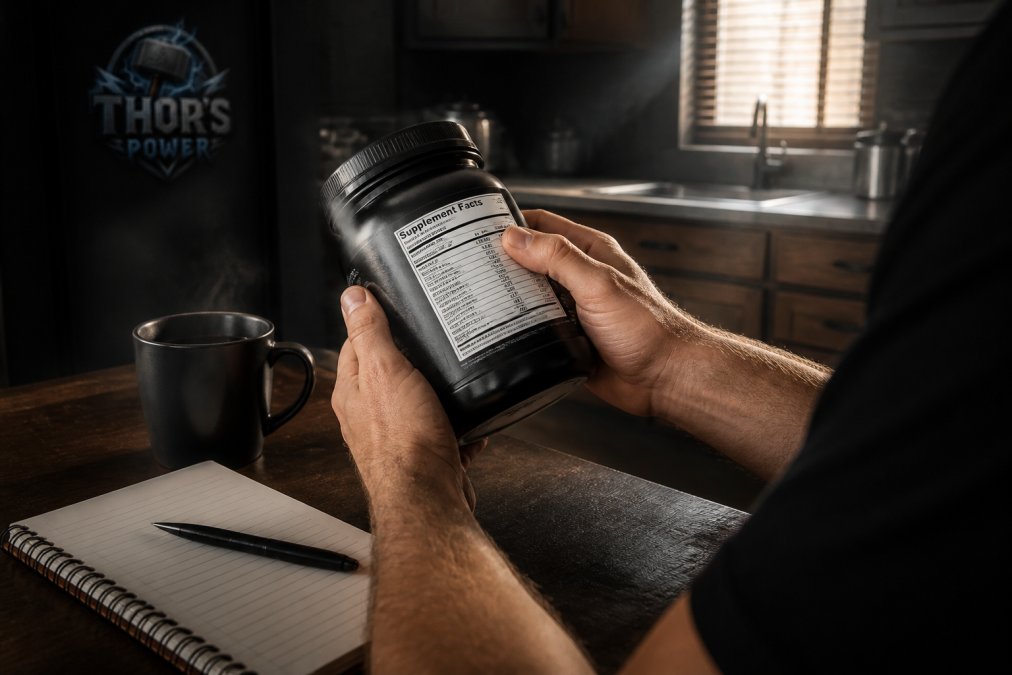
The Supplement Facts panel is the most important part of any bottle, and it is where transparency either holds up or falls apart. Learning how to read supplement labels for transparency starts here, because this panel is the only place a company is legally required to show what is inside. At Thor's Power, we built our own Bifröst Energy Patrol around a fully disclosed formula, so we know how much the panel matters.

Serving Size and Servings Per Container
Serving size is the amount the numbers on the panel refer to, not the amount you should take. A bottle might list two capsules as one serving while holding 60 capsules, which means 30 servings per container. Always check this line before comparing two products. A cheaper bottle with fewer servings can cost more per dose.
Daily Value Percentages and What They Tell You
Daily Value percentages show how much of a nutrient one serving provides compared to a daily reference amount. A vitamin at 100% DV meets the daily target for most adults. But many herbal ingredients have no established DV, so the panel shows a symbol instead of a number. That gap is normal, and it is also where vague dosing hides.
Proprietary Blend Meaning and Why It Hides Doses
The proprietary blend meaning comes down to one thing: a total weight with no individual amounts. A label might list a blend at 1,200 mg, then name five ingredients underneath without saying how much of each is inside. You cannot judge a dose you cannot see. This is the single most common trick in the industry, and it is worth understanding before you buy anything.
Supplement Label Red Flags That Signal Weak Transparency
Most red-flag lists stop at the obvious: a missing expiration date, a blank manufacturer line, a proprietary blend. Those matter, but they are the easy catches. The harder work is spotting the tactics that stay fully inside the law while still keeping you from knowing what you are buying. Here is what to watch for, ordered from the obvious to the sneaky.
The obvious flags:
- A proprietary blend with a total weight but no individual doses
- Ingredient names with no common name in plain English
- No expiration date or lot number anywhere on the package
- Structure-function claims like "supports immunity" with no supporting detail
- No manufacturer name, address, or contact information
The legal-but-deceptive flags most guides skip:
- Fairy dusting. A company adds a token amount of a trendy ingredient, say, a few milligrams of a mushroom extract, just so it can print that ingredient on the front of the bottle. The amount is technically present, so the claim is technically true. It is also meaningless. If the amount is not disclosed on the panel, assume it is small.
- Blend splitting. Instead of one 1,200 mg proprietary blend, the label lists two 600 mg blends with overlapping ingredients. The total is identical, but the math is harder to follow and the individual doses stay hidden.
- Serving-size games. A label lists a tiny serving size, one capsule, so the numbers per serving look competitive. But the effective dose most practitioners cite requires three or four capsules, which means you are paying for a fraction of what the front label implies.
- "Other Ingredients" misdirection. A formula markets itself as "clean" while the Other Ingredients line carries magnesium stearate, silicon dioxide, titanium dioxide, or artificial colors. None of these are illegal. None are necessarily harmful for most people. But they contradict the clean-label story the front of the bottle is telling.
- Proprietary blend by another name. Terms like "herbal matrix," "enzyme complex," "adaptogenic blend," and "proprietary extract" all function the same way: a total weight with no per-ingredient disclosure. The wording changes; the opacity does not.
- Unverifiable certification seals. A seal that looks like a third-party test mark but does not appear in the certifying body's public product database is decoration, not verification. Always check the certifying organization's website before trusting the seal.
Fillers, Excipients, and Additives to Question
Fillers and excipients are inactive ingredients used to bulk up a capsule, aid flow during manufacturing, or extend shelf life. Many are harmless. Some are worth a second look depending on your sensitivities. Read the "Other Ingredients" line and flag anything you do not recognize:
- Magnesium stearate, a common flow agent; generally considered safe, but often used as a marker of high-speed, low-cost manufacturing.
- Silicon dioxide, an anti-caking agent; widely used, generally inert.
- Titanium dioxide, a whitening agent; its use in food and supplements has drawn increased scrutiny in recent years.
- Artificial colors (FD&C dyes), purely cosmetic; some people choose to avoid them.
- Hydrogenated oils, used as a carrier in some softgels; a marker of older formulations.
Allergens and the "May Contain" Line
Federal labeling rules require the nine major food allergens, milk, eggs, fish, crustacean shellfish, tree nuts, peanuts, wheat, soybeans, and sesame, to be declared when they are intentional ingredients. What the rules do not require is a "may contain" statement for cross-contamination. If you have a serious allergy, look for a voluntary allergen statement and, better, a facility-level certification. A label that says nothing about allergens is not the same as a label that says "allergen-free."
Bifröst Energy Patrol Premium No Crash →
Third-Party Supplement Testing and Certification Marks
Third-party supplement testing means an outside lab checks what is actually in the bottle, not what the label claims is in the bottle. It verifies identity, potency, purity, and whether the contents match the panel. This matters because the FDA does not test products before they reach shelves. A seal is the closest thing to independent proof a consumer can get, but only if you know what the seal actually covers.
What the Major Seals Actually Verify
Not all certification marks are equal. Here is what the most commonly seen programs cover:
- NSF Certified for Sport, tests for banned substances in addition to identity, potency, and contaminants. Batch-level testing. The most rigorous mark for athletes subject to drug testing.
- NSF Contents Certified, verifies label claims and screens for contaminants, but does not screen for banned substances. Batch-level.
- USP Verified Mark, verifies that the product contains the ingredients listed, in the declared amounts, and that it does not contain harmful levels of specified contaminants. Batch-level, with periodic audits of manufacturing facilities.
- Informed Choice / Informed Sport, screens every batch for a broad panel of banned substances. Common in sports nutrition.
- ConsumerLab.com, an independent testing organization that publishes results; products are tested but the mark is not printed on most bottles. You check the website, not the label.
How to Verify a Seal in Under Two Minutes
- Note the certifying body's name from the seal.
- Go to that organization's website and search its public product database.
- Confirm the exact product name, the manufacturer, and the lot number if the database lists one.
- If the product is not in the database, treat the seal as unverified, regardless of how official it looks on the bottle.
What Seals Do Not Cover
A third-party seal verifies that the bottle contains what the label says. It does not verify that the dose is effective, that the ingredients work for your goal, or that the formula is well-designed. A perfectly tested product can still be a poorly dosed one. Testing answers the question "is this what it says it is?" It does not answer "is this worth taking?" Those are separate questions, and only a fully disclosed panel lets you evaluate the second one.
What the FDA Does and Does Not Regulate on Labels
The FDA regulates supplement labels and manufacturing practices, but it does not approve products before sale (the FDA). Under the FDA's dietary supplement overview, companies are responsible for safety and accurate labeling on their own. The agency steps in after a problem appears, not before. That is why label accuracy and quality assurance fall on the brand, and why reading the label yourself matters.
How to Read Supplement Labels for Transparency in 5 Steps
- Check the serving size and servings per container. This tells you the real cost per dose.
- Scan for a proprietary blend. If you see one, note that individual doses are hidden.
- Read the Daily Value percentages. High or low, they show how the dose compares to a daily target.
- Review the Other Ingredients line. Look for fillers and additives you want to avoid.
- Find the certification mark and lot number. Then verify the mark with the certifying body.
A transparent label passes all five steps without excuses. Thor's Power builds every formula this way, including Bifröst Energy Patrol, which lists each ingredient amount with no proprietary blend and ships in 30-serving tubs or single-serving sachets. For anyone who works long shifts and needs steady focus, that kind of clarity is the whole point. You can shop Bifröst Energy Patrol and read the panel yourself before you buy.
Frequently Asked Questions
How do I distinguish between a proprietary blend and a transparent label?
A proprietary blend lists ingredients under one combined weight without individual amounts, so you cannot tell how much of each you get. A transparent label lists every ingredient with its exact milligram amount per serving. If you see the words 'proprietary blend' or 'other ingredients' followed by a single number, the doses are hidden. Transparent formulas, like those with no proprietary blend, show each dose so you can compare against research and your own tolerance.
What are the red flags to look for on a supplement label?
Watch for proprietary blends that hide individual doses, vague ingredient names like 'herbal energizer' instead of the plant's common name, missing allergen disclosure, no lot number or expiration date, and claims like 'cures fatigue' that go beyond structure-function language. Also check for third-party testing seals. A label that lists every ingredient with its amount, plus a verifiable certification, gives you far more confidence than one that relies on marketing phrases.
How can I tell if a supplement is third-party tested?
Look for a certification mark from an independent testing body, such as NSF Certified for Sport, USP Verified, or Informed Choice. These programs verify that the product contains what the label claims and is free from contaminants. You can also check the brand's website for a certificate of analysis (COA) tied to the lot number on your container. If a brand does not publish test results or carry a seal, you have no independent proof of label accuracy.
Why is ingredient transparency important for high-performance supplements?
When you rely on a supplement for energy, focus, or recovery, you need to know exactly what you are putting in your body and how much. Transparent labels let you check caffeine content against your sensitivity, avoid allergens, and confirm that active compounds are dosed at levels supported by research. For shift workers and first responders, hidden stimulant doses or undeclared fillers can mean an unexpected crash or stomach upset mid-shift. Clear dosing removes the guesswork.