
October 19, 2026 — Editorial Team
How to Stack Amino Acids for Recovery After Shift Work

Table of Contents
- What You'll Need Before You Stack Amino Acids
- How Amino Acid Stacking Works for Shift Work Recovery
- Step 1: Choose Your Base With Essential Amino Acids for Muscle Recovery
- Step 2: Decide Between Amino Acids vs Protein Powder for Recovery
- Step 3: Time Your Stack: When to Take Amino Acids After a Workout
- Step 4: Build Recovery Nutrition for Night Shift Workers
- Common Mistakes to Avoid When Stacking Amino Acids
- Conclusion
- Frequently Asked Questions
Last Updated: October 13, 2026
What You'll Need Before You Stack Amino Acids
Learning how to stack amino acids for recovery after shift work starts with knowing what actually drives muscle repair when your sleep schedule is upside down. At Thor's Power, we build formulas for first responders and night shift crews, so we treat recovery as an operational requirement, not an afterthought. Before you buy anything, gather a few basics.
Here's your starting kit:
- A shaker bottle you can clean fast
- A written log of your shift pattern
- A protein source you'll actually eat
- A water bottle you refill on shift
- A quiet, dark place to sleep after work
That last item matters more than any powder. The CDC guidance on shift work and sleep explains why irregular hours disrupt the body clock. No supplement fixes a schedule that never lets you sleep.
How Amino Acid Stacking Works for Shift Work Recovery
Amino acid stacking is the practice of combining specific amino acids, in set amounts, at set times, to support muscle repair, mental focus, and energy between shifts. It works because different amino acids do different jobs, and your body uses them at different points in the recovery window.
The Three Recovery Jobs Amino Acids Handle
Think of aminos as three separate crews:
- Repair: Essential amino acids, especially leucine, trigger muscle protein synthesis.
- Focus: L-tyrosine and acetyl L-carnitine support attention when you're tired.
- Calm: L-theanine takes the edge off caffeine without dulling your alertness.
Each crew has its own timing. Stacking them together in one scoop sounds tidy, but it rarely matches how your shift actually runs.
What Changes When Your Body Clock Is Off
Night work flips your hunger, digestion, and hormone cycles. Your body handles a meal at 3 a.m. differently than one at noon. That's why recovery nutrition for night shift workers has to be flexible, not a rigid schedule copied from a day-shift plan.
Step 1: Choose Your Base With Essential Amino Acids for Muscle Recovery
Your base layer should be essential amino acids, because your body cannot make them on its own. Essential amino acids for muscle recovery do the heavy lifting: they supply the raw material your muscles need to rebuild after physical work.
For most shift workers, we recommend this order:
- Pick an EAA blend with all nine essential aminos listed by amount.
- Check that leucine appears near the top of the label.
- Avoid proprietary blends that hide individual doses.
- Start with one serving per day, not three.
If you lift before or after your shift, take your EAA base within an hour of finishing. If your job itself is physical, treat the end of your shift as the training session and refuel then.
Step 2: Decide Between Amino Acids vs Protein Powder for Recovery
The choice between amino acids vs protein powder for recovery comes down to speed and convenience, not superiority. Both work. They just fit different moments in a shift worker's day.
| Option | Best For | Speed | Practical Note |
|---|---|---|---|
| EAA blend | Fast post-shift repair | Fast | Light on the stomach |
| Whey protein | Full meal replacement | Slower | Needs a shaker and water |
| Casein | Overnight repair | Slowest | Best before sleep |
Here's the honest take: if you eat real meals on a normal schedule, protein powder covers most of your needs. If your meals are erratic and you need something light at 5 a.m., aminos win. Many of our customers use both, aminos right after shift and protein with their main meal.
Step 3: Time Your Stack: When to Take Amino Acids After a Workout
The best time to take amino acids after a workout is within 30 to 60 minutes of finishing, when blood flow to working muscles is still elevated. For shift workers, that window usually lands right after your shift ends, not at a gym.
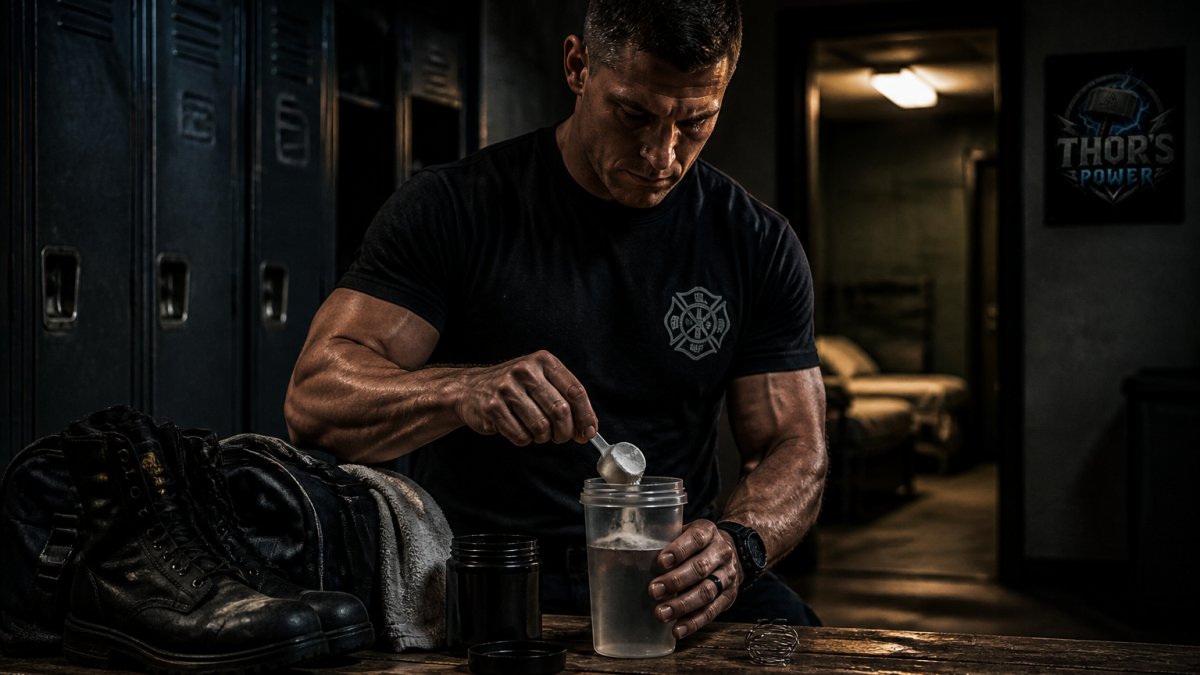
A simple timing rule:
- Post-shift: EAAs plus water within an hour
- Pre-sleep: a slow protein if you trained hard
- Mid-shift: a small dose of tyrosine for focus, not repair
The thing nobody tells you about timing is that consistency beats precision. Taking your aminos at the same point in every shift trains your body to expect them.
Step 4: Build Recovery Nutrition for Night Shift Workers
Recovery nutrition for night shift workers has to survive real life: skipped breaks, cold food, and a commute home in daylight. Build a plan you can repeat on your worst day, not your best one.
Start with these habits:
- Eat a real meal before your shift, not during it.
- Keep protein and aminos within reach at your station.
- Drink water on a schedule, not when you feel thirsty.
- Protect a sleep block like it's a meeting you can't move.
Thor's Power was founded by a deputy sheriff who worked these hours, so we know the gap between a plan on paper and a plan at 3 a.m. Our Bifröst Energy Patrol mix pairs 150 mg of caffeine with L-theanine, L-tyrosine, and taurine for steady focus, and it uses a transparent formula with no proprietary blend.
Common Mistakes to Avoid When Stacking Amino Acids
The most common mistake is treating aminos as a substitute for food and sleep. They support recovery, they don't replace it. Watch for these traps:
- Doubling doses to "catch up" after a bad shift
- Stacking stimulants with aminos and calling it recovery
- Ignoring hydration, which matters more on night shifts
- Skipping meals because the powder feels easier
- Copying a day-shift plan onto a night-shift body
A common mistake is buying the cheapest tub without reading the label. If the amounts aren't listed, you can't adjust your stack, and you can't tell what's working.
Conclusion
Stacking aminos for shift work is simple once you accept that your schedule, not a label, sets the plan. Build your base with essential amino acids, choose between aminos and protein based on your day, and time your dose around your shift.
Frequently Asked Questions
Which amino acids support muscle recovery after a long shift?
The core stack is the nine essential amino acids (EAAs), especially leucine, isoleucine, and valine, which drive muscle protein synthesis. Add glutamine for gut and immune support, and glycine for sleep quality. If you want a smaller stack, BCAAs cover the muscle-repair side, but EAAs give you the full set your body cannot make on its own. Pair them with enough total protein across the day, since amino acids top up recovery rather than replace it.
Should I take essential amino acids or protein powder for recovery?
It depends on how your shift eats into your meals. Protein powder gives you a full protein dose with calories, which suits a post-shift meal replacement. Essential amino acids are faster to absorb, lighter on the stomach, and easier to sip during a shift when you cannot sit down for a full shake. Many shift workers use EAAs around the shift and protein powder at the main meal, so the two are not competing.
Can I take amino acids before bed after working a night shift?
Yes. A dose of EAAs or a glycine-heavy blend taken 30 to 60 minutes before your daytime sleep can support overnight (for you, daytime) muscle repair without the stimulant load. Skip any blend that contains caffeine or green tea extract, since those will fight the sleep you just earned. Keep the serving small, around 5 to 10 grams, so digestion does not wake you.
Can amino acid supplements interfere with sleep or medications?
Some can. Tyrosine and phenylalanine are stimulating and belong earlier in your awake window, not before sleep. Tryptophan and glycine lean the other way and can help you wind down. If you take prescription medication, especially for blood pressure, thyroid, or mood, check with your prescriber before adding a stack, because amino acids compete for the same transporters and can shift how some drugs are absorbed.
Shift work wears down even the most disciplined crew, and recovery is where performance is won or lost. Thor's Power builds clean energy and performance supplements for first responders and shift workers, including Bifröst Energy Patrol for steady focus and a full line of amino-acid and muscle-support products in development. Get started with Thor's Power and build a recovery routine that holds up on your hardest shift.