
October 15, 2026 — Editorial Team
L-Theanine for Shift Work Focus: Benefits That Last

Table of Contents
- Why L-Theanine Fits the Shift Work Problem
- L-Theanine and Caffeine for Focus: The Synergy That Matters
- L-Theanine Dosage for Focus: Timing It Around Your Shift
- How to Stay Alert on Night Shift Without the Crash
- L-Theanine Side Effects and Safety Boundaries
- A Practical Shift-Work Focus Plan
- Conclusion: What L-Theanine Can and Cannot Do for Shift Workers
- Frequently Asked Questions
Last Updated: October 9, 2026
Why L-Theanine Fits the Shift Work Problem
Shift work breaks the body's natural rhythm. When your schedule flips between days and nights, your brain struggles to stay sharp at 3 a.m. and wind down at 10 a.m. That is where l-theanine for shift work enters the picture.
L-theanine is an amino acid found in tea leaves. It supports calm alertness, the kind of focused state you need during a 12-hour night shift. At Thor's Power, we built our formula around this exact problem because our founder worked patrol shifts himself. Below, we break down what the research says, how to time it, and where the limits are.
What L-Theanine Is and Where It Comes From
L-theanine is a naturally occurring amino acid found almost exclusively in tea leaves, especially green tea. It is the compound behind tea's reputation for calm focus rather than jittery energy.
Small amounts also appear in some mushrooms, but tea remains the main dietary source. Most supplements use a purified form. The key point for shift workers: l-theanine does not sedate you. It modulates brain activity in a way that supports relaxed attention, which is exactly what you need when you must stay vigilant but not wired.
How It Promotes Calm Alertness Without Sedation
L-theanine supports calm alertness by increasing alpha brain wave activity, a pattern linked to relaxed but wakeful states. Many users describe it as "quiet focus" rather than drowsiness.
That distinction matters on the job. A sedative makes you slow and foggy. L-theanine works differently. It appears to raise levels of GABA and other calming signals in the brain while keeping you awake and responsive.
For shift workers, this means you can handle complex tasks, radio calls, and attention-switching without the edge that comes from too much caffeine alone. The NIH Office of Dietary Supplements overview of L-theanine notes that research is still developing, so treat it as a support tool, not a cure.
L-Theanine and Caffeine for Focus: The Synergy That Matters
The combination of L-theanine and caffeine for focus is the most studied pairing in this space. Together, they tend to produce steadier attention than caffeine alone. But for shift workers, the pairing is only half the question. The other half is when to take each one across a shift that may run 10 to 12 hours.
Caffeine sharpens alertness but can bring jitters, anxiety, and a hard crash. L-theanine smooths that curve. Many people report better concentration and less of a spike-and-crash cycle when the two are combined.
| Goal | Caffeine Alone | Caffeine + L-Theanine |
|---|---|---|
| Fast alertness | Strong | Strong |
| Jitter control | Weak | Better |
| Crash risk | Higher | Lower |
| Focus on complex tasks | Mixed | Steadier |
| Sleep protection after shift | Poor if dosed late | Better if paired and tapered |
A Caffeine Timeline for a 12-Hour Night Shift
A common pattern that works for many shift workers looks like this:
- Shift start (e.g., 7 p.m.): 100-150 mg caffeine with 100-200 mg L-theanine. This is your anchor dose.
- Midpoint (e.g., 1 a.m.): Optional second dose of 50-100 mg caffeine with 100 mg L-theanine if focus is slipping. Keep it smaller than the first.
- Last third of shift (after ~3 a.m. for a 7 p.m. start): No more caffeine. Switch to water, a light snack, and if needed, L-theanine alone to take the edge off without adding stimulant.
- Pre-sleep (60-90 minutes before bed): No caffeine at all. L-theanine alone at 100-200 mg is sometimes used to support wind-down, though evidence for sleep onset is mixed.
Why the Ratio Matters
Research on the caffeine-L-theanine combination most often uses a ratio in the range of 1:1 to 2:1 (L-theanine to caffeine), though studies vary. A 150 mg caffeine dose paired with 100-200 mg L-theanine is a common range. Going much higher on L-theanine does not necessarily improve focus and may make some people drowsy.
This is why we built Bifröst Energy Patrol with 150 mg of caffeine alongside L-theanine, plus L-tyrosine and Alpha GPC. The goal is smooth energy, not a hard hit followed by a slump by hour 18.

The Crash You Are Actually Avoiding
The "crash" shift workers describe is not just caffeine wearing off. It is the combination of caffeine clearance, circadian low point (typically 3-5 a.m. for night workers), and accumulated sleep debt. L-theanine does not erase any of those. It smooths the edges so you can function through them. If you are relying on a third or fourth caffeine dose to stay upright, that is a signal your sleep plan needs attention, not your supplement stack.
L-Theanine Dosage for Focus: Timing It Around Your Shift
A typical L-theanine dosage for focus ranges from 100 to 200 mg, taken 30 to 60 minutes before you need peak attention. Timing matters more than the exact number.
For a night shift, that often means taking it just before your shift starts. If you hit a wall mid-shift, a second smaller dose can help without wrecking your sleep later.
A few practical rules:
Bifröst Energy Patrol Premium No Crash Energy →
- Start low, around 100 mg, to see how you respond
- Pair it with caffeine for sharper focus
- Avoid a large dose within 4 to 6 hours of planned sleep
- Keep a consistent routine so you learn your own response
The FDA guidance on dietary supplement labeling reminds buyers that supplements are not reviewed for effectiveness before sale, so choose transparent formulas you can read.
How to Stay Alert on Night Shift Without the Crash
Knowing how to stay alert on night shift comes down to three levers: light, timing, and smart stimulant use. L-theanine supports the third lever.
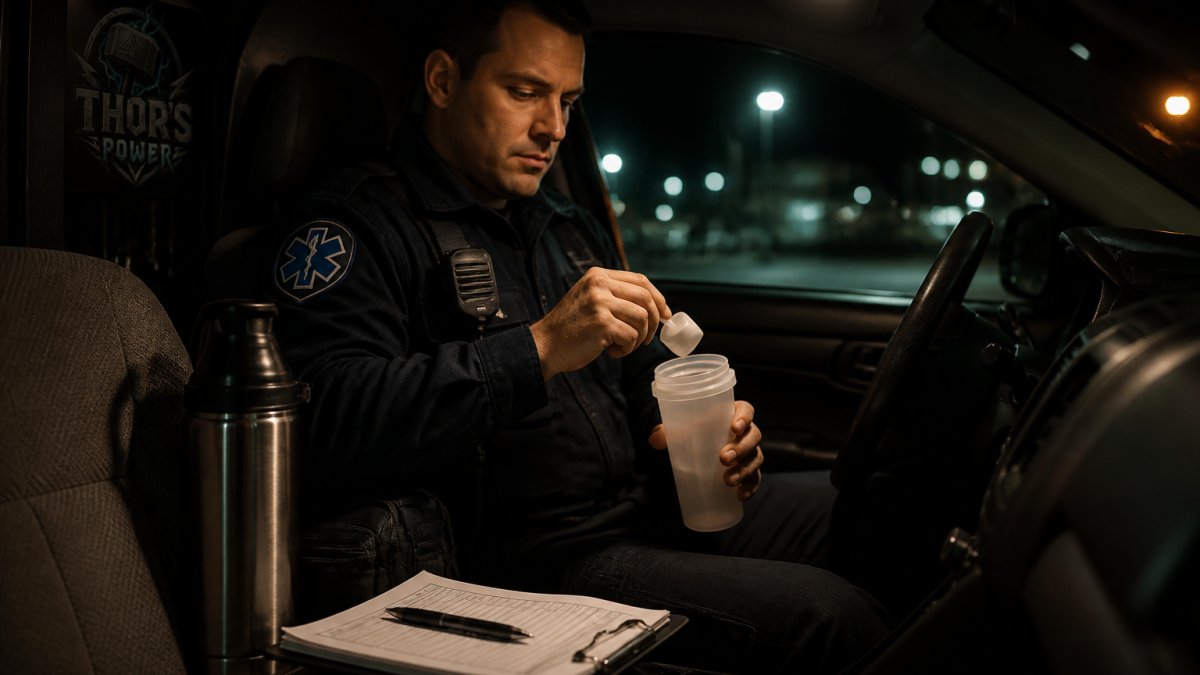
Start with light. Bright light early in your shift tells your brain it is "daytime." Dim light near the end helps you wind down for sleep.
Then manage caffeine. A steady, moderate intake beats a giant dose. Pair it with L-theanine to blunt the spike.
L-Theanine Side Effects and Safety Boundaries
L-theanine side effects are generally mild in healthy adults. Reported issues are rare and usually minor, such as a headache or stomach upset.
Safety boundaries still matter. Talk to a doctor first if you:
- Take blood pressure or sedative medications
- Are pregnant or nursing
- Have a diagnosed sleep disorder like shift work sleep disorder
Shift work sleep disorder is a real medical condition, not just "being tired." If you cannot sleep even when your schedule allows it, that is a clinical issue. See a provider rather than self-treating. The CDC information on shift work and sleep outlines how irregular schedules affect health.
A Practical Shift-Work Focus Plan
A workable plan combines timing, caffeine strategy, light exposure, and sleep protection. L-theanine is one lever, not the whole machine. Here is a framework you can adapt to nights, rotating schedules, or 24-hour duty.
Before Your Shift
- Sleep first. If you are coming off a day schedule, a 90-minute nap before your first night shift blunts the worst of the transition.
- Light: Get bright light in the first hour you are awake, even if that is 5 p.m. This helps anchor your rhythm to the new schedule.
- Supplement: 100-200 mg L-theanine with a moderate caffeine dose (100-150 mg) about 30-60 minutes before you need peak attention.
Early in the Shift
- Light: Bright light for the first half of your shift tells your brain it is "daytime." If your workplace allows it, a 10,000 lux lamp for 20-30 minutes early in the shift is a common approach.
- Hydration: Dehydration mimics fatigue. Keep water within reach and sip steadily.
- Movement: A 5-minute walk every 90 minutes does more for alertness than most people expect.
Mid-Shift
- Caffeine: If focus dips, a small second dose (50-100 mg) with 100 mg L-theanine. Keep it smaller than the first.
- Food: A light protein-and-fat snack beats a heavy carb meal for sustained energy. Heavy meals pull blood toward digestion and away from the focus you need.
- Break: Take your breaks. A 15-minute break with movement and water resets more than pushing through.
Late Shift
- Caffeine cutoff: Stop caffeine by the final third of your shift. For a 7 p.m. to 7 a.m. shift, that means no caffeine after roughly 3 a.m.
- Light: Dim the lights near the end of your shift if you can. This signals your brain that wind-down is coming.
- Supplement: L-theanine alone (100-200 mg) if you want to take the edge off without adding stimulant.
After Shift
- Light: Wear sunglasses on the commute home if it is daylight. Morning light is the strongest signal to your brain that it is time to be awake.
- Sleep environment: Dark, cool, quiet room. Blackout curtains, a white noise machine, and a cool temperature (around 65-68°F) are standard tools for day sleep.
- Consistency: Try to sleep at the same time after every shift, even on days off. Rotating your sleep schedule back and forth is what makes shift work hardest on your body.
What This Plan Does Not Do
This plan does not reset your circadian rhythm. It does not treat shift work sleep disorder. It does not replace medical advice if you have a diagnosed sleep condition or take medications that interact with stimulants or sedatives. What it does is stack small, evidence-informed habits so that L-theanine and caffeine are working with your routine instead of against it.
Conclusion: What L-Theanine Can and Cannot Do for Shift Workers
L-theanine can support calm, steady focus and smooth out caffeine's rough edges. It cannot fix a broken sleep schedule on its own.
If you work nights, rotating shifts, or 24-hour duty, you need a routine built for real demands. That is why we make Bifröst Energy Patrol, a no-crash energy mix with 150 mg of caffeine, L-theanine, and a transparent, no-proprietary-blend formula. Stock up with the Loki Bundle for 90 servings of Blue Raspberry. Shop Thor's Power and stay sharp when the shift keeps going.

Frequently Asked Questions
Does L-theanine help focus during a night shift?
L-theanine supports calm alertness and attention, which is exactly what night shift work demands. Research on the amino acid points to short-term improvements in attention and vigilance, and it pairs well with caffeine for tasks that require sustained concentration. It will not replace sleep, and it does not override the effects of serious sleep deprivation. Think of it as one layer of a shift-work focus plan that also includes strategic caffeine timing, light exposure, and protected recovery sleep.
Can you take L-theanine with caffeine?
Yes, and the combination is one of the most studied pairings in the supplement space. Caffeine sharpens alertness but can bring jitters and a spike-and-crash pattern. L-theanine is often stacked with it to smooth that edge and support steadier focus. A common ratio is roughly 1:1 or 2:1 L-theanine to caffeine, so if your energy drink mix has 150 mg of caffeine, 100 to 200 mg of L-theanine fits that range. Follow the label directions on whatever product you use.
How long does L-theanine take to work?
Most people notice effects within 30 to 60 minutes of taking it, which makes timing straightforward: take it 30 to 60 minutes before the part of your shift that demands the most attention, not at the start of every shift out of habit. Effects typically fade over a few hours. If you use a powdered energy mix that already contains L-theanine, the timing is built in when you drink it, so plan your serving around your hardest stretch of work.
Is L-theanine safe to take before work?
For most healthy adults, L-theanine is well tolerated and does not cause drowsiness at typical doses. Reported side effects are mild and uncommon, and it is not a sedative, so it should not impair your ability to drive or respond to calls the way alcohol or sleep medication would. If you take blood pressure medication, have a diagnosed sleep disorder, or are pregnant or nursing, talk to a healthcare professional first. Caffeine sensitivity matters too, so watch total caffeine across a shift.