
November 12, 2026 — Editorial Team
What Makes High Quality Pre Workout Supplements Worth It

Last Updated: November 9, 2026
Quick Summary
High quality pre workout supplements are products with fully disclosed ingredient amounts, third-party testing, and doses that match the research, not a proprietary blend that hides what you're actually taking. Transparent labels list every active ingredient with its own amount, so you know whether you're getting a real dose or filler.
- Proprietary blends hide individual doses, so you can't tell if an ingredient is present at a useful amount.
- Third-party testing confirms label accuracy and purity but doesn't prove a formula suits you.
- A 150 mg caffeine serving is a measured starting point for shift work.
- Test any new product at half a scoop on a day off, never on shift.
- Divide the tub price by the number of servings to work out cost per serving.
Table of Contents
- What Makes High Quality Pre Workout Supplements Worth It
- What Defines High Quality in Pre-Workout Supplements?
- How to Choose the Right Pre-Workout for Your Shift
- Key Ingredients to Look For and What They Do
- Caffeine Limits for Shift Workers: How Much Is Too Much
- How to Avoid the Pre-Workout Crash
- Safety, Side Effects, and Drug Interactions
- How to Test Your Tolerance Before You Commit
- Frequently Asked Questions
What Makes High Quality Pre Workout Supplements Worth It
High quality pre workout supplements are products with fully disclosed ingredient amounts, third-party testing, and doses that match the research, not a proprietary blend that hides what you're actually taking. The global pre-workout market is valued at roughly $22.48 billion in 2026 and projected to reach $31.53 billion by 2031, according to Mordor Intelligence's pre-workout supplements market report. That growth means more labels to sort through, and most of them don't earn your trust.
Below, we'll show you exactly what separates a worthwhile formula from a dressed-up stimulant dump, and how to test one before you commit.
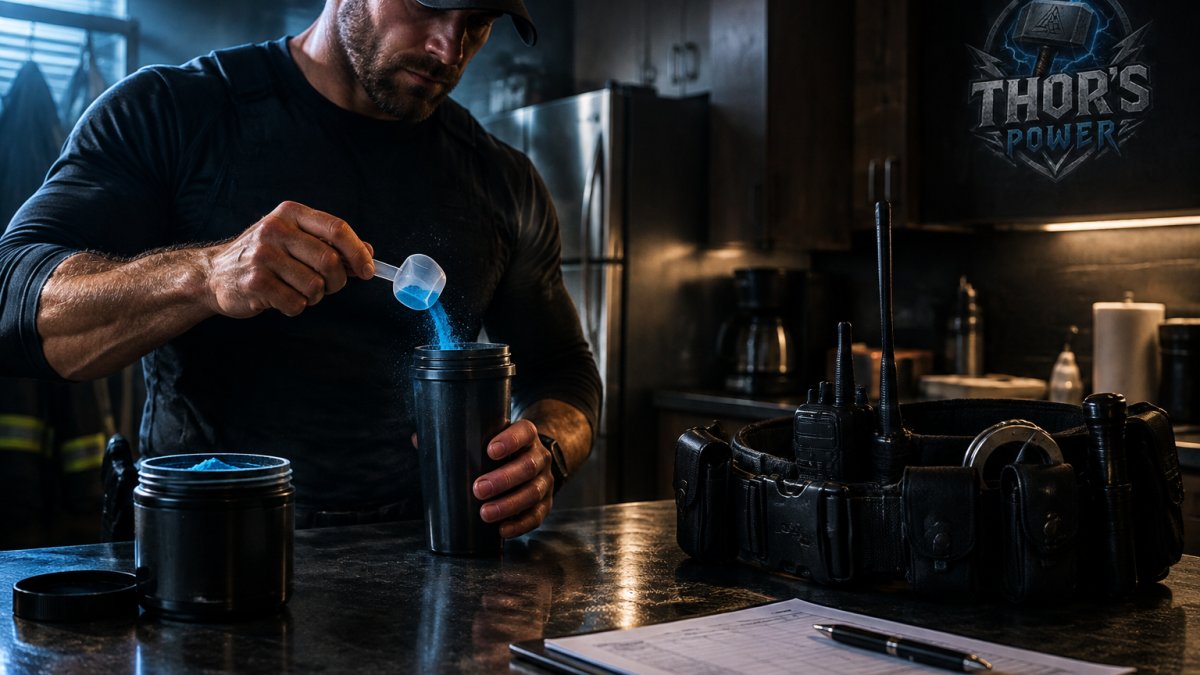
Quick Takeaways
- Transparent labels with individual ingredient amounts beat proprietary blends every time.
- Third-party testing (NSF International, U.S. Pharmacopeia) signals quality but doesn't guarantee a formula suits you.
- 150 mg of caffeine per serving is a measured starting point for shift work; stack all caffeine sources before adding more.
- Test any new product at half a scoop on a day off before you trust it on shift.
- The FDA regulates supplements under a different framework than drugs, so label accuracy is largely on the manufacturer.
What Defines High Quality in Pre-Workout Supplements?
Quality in pre-workout supplements comes down to three things: disclosed doses, verified purity, and ingredients that match their stated purpose. Everything else is marketing. A 2025 review in PubMed Central on multi-ingredient pre-workout supplements reports that these formulas may support energy, focus, and endurance, but only when the doses are actually present.
Transparent Labels Beat Proprietary Blends
A proprietary blend lumps ingredients under one total milligram count, so you never know if you're getting 5 grams of citrulline or 500 mg. Transparent labels list every active ingredient with its own amount. Bifröst Energy Patrol, for example, prints all eight actives individually, including 1,000 mg L-taurine, 750 mg L-tyrosine, and 150 mg caffeine anhydrous. If you want a practical walkthrough on decoding those panels, read our guide on how to read supplement labels for transparency.
Third-Party Testing and What It Actually Proves
Third-party testing confirms a product contains what its label claims and is free of banned substances. What third-party testing doesn't prove is that the formula works for you, your shift, or your training, so certification narrows the field but doesn't replace your own judgment.
How to Choose the Right Pre-Workout for Your Shift
Match the formula to your actual demand, not to a gym influencer's routine. A 12-hour night shift and a heavy leg day call for different timing, different caffeine ceilings, and different supporting ingredients. Start with your schedule, then filter by dose transparency, stimulation level, and dietary fit.
| Your Situation | What to Prioritize | Watch For |
|---|---|---|
| 12-hour night shift | Moderate caffeine, focus nootropics | Total daily caffeine stacking |
| Pre-workout training | Citrulline, beta-alanine, creatine | Underdosed blends |
| Sensitive stomach | Fewer fillers, simple formulas | Sugar alcohols, dyes |
| Late shifts near bedtime | Lower stim or stim-free | Long half-life caffeine |
| Budget-focused | Cost per serving | Cheap scoops with hidden blends |
Work out your cost per serving before you buy: divide the tub price by the number of servings. A $49.99 tub with 30 servings runs about $1.67 per serving. When you're ready to compare formulas built to this standard, browse our high-end supplements collection.
Key Ingredients to Look For and What They Do
The ingredients worth paying for are the ones with a disclosed dose that matches the research range. Below is what each one does, the range most studies use, and where the label usually falls short.
L-citrulline supports nitric oxide production and blood flow, which drives the muscle pump. Research typically uses 3 to 6 grams of L-citrulline or roughly 1.5 to 3 grams of citrulline malate, per NIH Office of Dietary Supplements. Many labels list citrulline inside a blend, so you can't tell whether you're getting 6 grams or 600 mg.
Beta-alanine is a common pre-workout ingredient. Check whether the label expects you to take it daily or only before training, since a single scoop may not carry a full daily amount.
Creatine monohydrate at 5 grams per day is the standard benchmark for strength and power output, per NIH creatine fact sheet. It works through saturation over weeks, not minutes, so timing before a shift matters less than taking it consistently.
Caffeine anhydrous delivers the stimulant effect. A 150 mg serving is a measured starting point for shift work, and the Mayo Clinic caffeine guidance puts the general adult ceiling near 400 mg per day from all sources.
L-theanine is paired with caffeine in Bifröst Energy Patrol at 200 mg per serving.
L-tyrosine and Alpha GPC are included in Bifröst Energy Patrol at 750 mg and 300 mg (of the 50% ingredient) per serving.
L-taurine is included in Bifröst Energy Patrol at 1,000 mg per serving. Rhodiola rosea root powder is included at 200 mg per serving.
Branched-chain amino acids and electrolyte replenishment have their place, especially for hydration on long shifts. The rule is simple: if the label won't tell you the dose, assume it's too low to matter.
A Quick Ingredient Reference
| Ingredient | What It Does | Common Research Range |
|---|---|---|
| L-citrulline | Nitric oxide, blood flow, pump | 3-6 g |
| Beta-alanine | Buffers muscle acid, endurance | 3.2-6.4 g/day |
| Creatine monohydrate | Strength and power | 5 g/day |
| Caffeine anhydrous | Alertness, energy | 150-400 mg/day total |
| L-theanine | Smooths caffeine edge | 100-200 mg |
| L-tyrosine | Focus under stress | 100-150 mg/kg |
| Alpha GPC | Cognitive focus | 300-600 mg |
| L-taurine | Supports formula, hydration | 500-2,000 mg |
Watch out: a label can list every ingredient by name and still underdose each one. Match the printed amount against the range above before you trust the formula.
Caffeine Limits for Shift Workers: How Much Is Too Much
Most healthy adults can tolerate up to about 400 mg of caffeine per day, per Mayo Clinic guidance on caffeine. For shift workers, the practical ceiling is lower, because coffee, soda, and energy drinks stack on top of your pre-workout. A 150 mg serving is a measured starting point. If you're mapping out timing across a night rotation, our guide on when to drink caffeine on night shift breaks it down hour by hour.
Watch out: taking a full scoop late in a long shift can wreck the sleep you need before the next one.
How to Avoid the Pre-Workout Crash
The crash usually comes from too much fast caffeine and too little support. Pairing caffeine with L-theanine is one approach to smoothing the curve, and Bifröst Energy Patrol contains 150 mg caffeine with 200 mg L-theanine per serving. You can see the full formula on the Bifröst Energy Patrol page. For a broader plan on dodging the mid-shift slump, read how to avoid energy crashes during night shifts.

Other levers that matter: eat protein before your shift, sip water steadily, and don't chase the first cup with three more. A jitter-free curve beats a spike every time.
Safety, Side Effects, and Drug Interactions
Pre-workout supplements are not automatically safe because they're sold as supplements. Stimulant-heavy products can cause side effects, so start with a measured dose.
The Stacking Audit Most Guides Skip
Most people who get into trouble aren't taking one product, they're stacking several without counting the overlap. Before you add a pre-workout, list everything you already take in a day and total the caffeine. A 150 mg pre-workout plus a large coffee (roughly 95 mg), a soda (about 35 mg), and a mid-shift energy drink can push you past the 400 mg daily ceiling without you noticing.
Run this audit once a week:
- Write down every caffeine source and its approximate milligrams.
- Add them up. If you're near 400 mg by mid-shift, cut a source before adding one.
- Check for duplicate actives, two products both listing taurine, tyrosine, or beta-alanine can double a dose you didn't intend.
- Space new products at least a week apart so you can tell what's causing a reaction.
- Note anything that keeps you awake past your target bedtime and remove it from the rotation.
Interactions Worth Knowing
Stimulant medications, some decongestants, and certain blood pressure drugs can compound the effect of caffeine. If you take any of these, talk to your doctor before adding a pre-workout. The same applies if you have a heart condition, are pregnant or nursing, or are sensitive to caffeine.
Watch out: don't stack multiple stimulant products in one day, and don't take a full scoop late in a 12-hour shift, the sleep you lose is the energy you'll chase tomorrow. If you're mapping timing across a rotation, our guide on natural ways to stay awake on night shift covers the non-stimulant levers first.
How to Test Your Tolerance Before You Commit
Test at half a scoop on a day off, never on shift. Wait 45 to 60 minutes, note your heart rate, focus, and stomach response, then decide whether a full serving is right for you. Repeat once more before you trust it on a 12-hour rotation. This protocol costs you one serving and saves you a bad shift.
If you take other daily supplements, space new products apart so you can tell what's doing what. Keep a simple log: dose, time, and how you felt three hours later.
Your shift already asks enough of you. Don't hand it a formula you can't read. Thor's Power builds transparent, no-proprietary-blend supplements for people who work through the hardest hours, with individually listed doses, 150 mg caffeine per serving, and a focus-oriented formula in every tub. Get started with Thor's Power and bring measured energy to your next shift.
This article is for informational purposes only and is not medical advice. Consult a healthcare professional before starting any supplement.
Frequently Asked Questions
What is the highest quality pre-workout?
Quality comes down to a label that lists every active ingredient with its exact amount and a caffeine dose you can account for. Quality depends on knowing exactly what you are taking. Look for third-party testing through NSF International or U.S. Pharmacopeia, no proprietary blends, and a stimulant level that fits the rest of your day.
How much caffeine is too much in a day for active duty?
Most healthy adults can handle roughly 400 mg of caffeine per day, so a 150 mg serving leaves room for coffee later in the shift. The FDA regulates dietary supplements under a different framework than drugs, and USADA notes products are regulated post-market, so the label is your main source of truth. If you are stacking a pre-workout with energy drinks, add the numbers before you drink, not after.
How do stimulants in pre-workouts affect shift workers?
Time your last serving well before your planned bedtime so caffeine does not work against your sleep. Bifröst Energy Patrol contains 150 mg caffeine and 200 mg L-theanine per serving.
What should first responders look for on a pre-workout label?
Check four things: exact caffeine per serving, whether every ingredient amount is listed, whether a third party tested the product, and whether the stimulant level fits a shift that may run long. Avoid anything with a proprietary blend, since you cannot tell how much of each ingredient you are getting. Also scan for ingredients that interact with prescriptions you take, and clear new supplements with your doctor first.
How do I avoid the pre-workout crash on a long shift?
Keep the caffeine dose moderate, drink water alongside it, and eat something with protein before your shift starts. Bifröst Energy Patrol contains L-theanine and tyrosine alongside 150 mg caffeine per serving. Take your serving early enough that it wears off before bedtime, and do not double up when the first one fades.
